



Notes we’d send a friend
Updates from projects we're working on and lessons we're learning.
Sent when there's actually something to say.
.webp)
We published a blog post for Triad Vacation Rentals—just explaining three platform fee structures in one place. Eight weeks later, ChatGPT was citing us ahead of sites with years of domain authority.
In August 2025, we started working with Triad Vacation Rentals, a short-term rental property management company in North Carolina. Every time we sat down to write for their blog, we ran into the same wall.
We needed accurate fee information from all three major platforms at once: Airbnb, VRBO, and Booking.com. It didn't exist anywhere in one place. Three tabs open, cross-referencing documentation written to explain each platform in isolation. Nothing that helped anyone compare them side by side with real numbers.
At some point it clicked: if we kept running into this while writing, Triad's hosts were definitely running into it too. That's when the idea took shape. Build a simple resource with comparison tables that hosts could actually use. No brief, no targeting. Just answer the question we kept needing answered ourselves. The article came from that practical need, not from a content calendar or competitive analysis.
The terms around platform fees are owned by the platforms themselves. "Airbnb host fees," "VRBO commission," "Booking.com charges." When Airbnb publishes content about Airbnb fees, they don't just have authority. They are the source. No independent site competes with that on a head term, regardless of how long it's been around.
Triad's site had five months of SEO history at the time. We do keyword research for most content, and we had a baseline keyword list for this topic. But one look at the competition told us everything we needed to know. Those head terms belonged to the platforms. No independent site was going to compete with that, regardless of domain age.
So we didn't chase them. We focused on the question behind the keyword instead. Not "Airbnb host fees" as a phrase to rank for, but the actual problem a host is trying to solve when they search it.
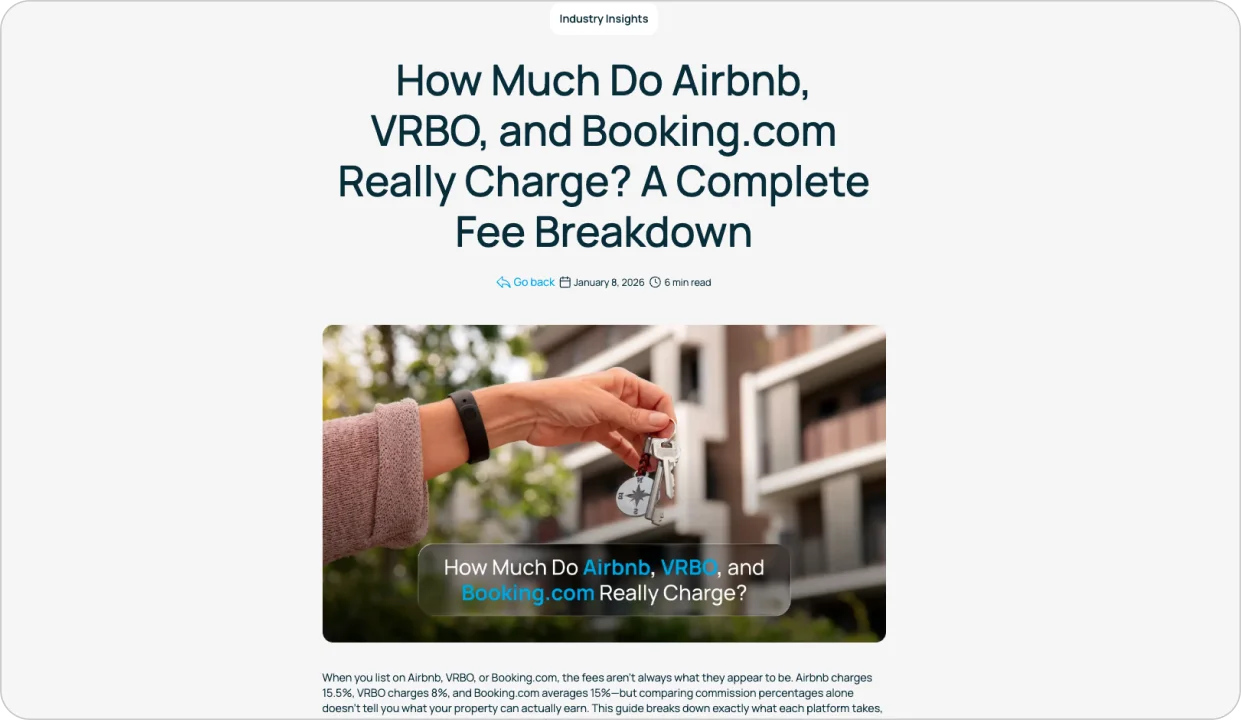
We wrote, "How Much Do Airbnb, VRBO, and Booking.com Really Charge? A Complete Fee Breakdown"—the article we kept wishing existed. One place, all three platforms, a comparison table, and actual payout calculations broken down line by line.
Published January 8, 2026. The goal was simple: give Triad's hosts something useful they could read in five minutes and walk away actually understanding what they earn after platform fees. Written for one specific reader. A Triad host sitting with their morning coffee trying to make sense of three different fee structures.
Eight weeks after publishing, Google Analytics showed 72 sessions from ChatGPT—a small volume, but the engagement rate told a different story.
ChatGPT traffic posted a 72% engagement rate, the highest of any source on the site:
Average engagement time was 1 minute 23 seconds, with 7.47 events per session. ChatGPT became the 5th largest traffic source, ahead of Facebook, email marketing, and LinkedIn combined.
When we checked ChatGPT directly, Triad was being cited as a source in response to fee comparison queries:
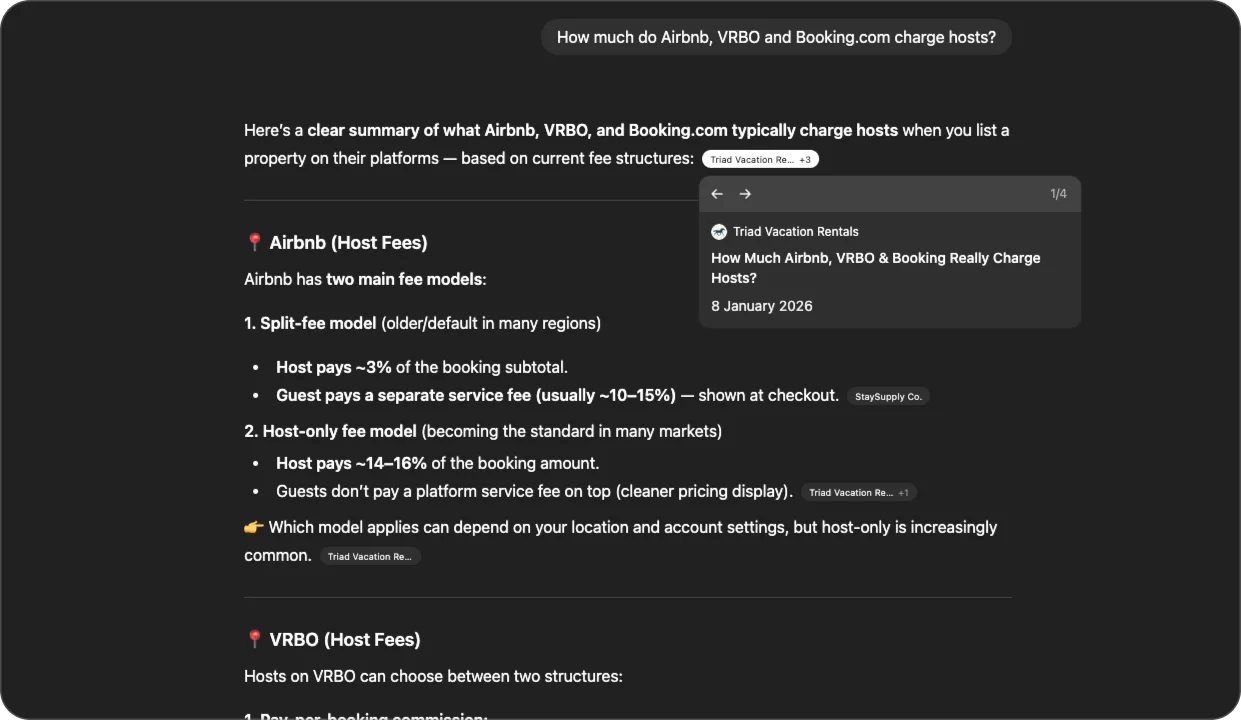
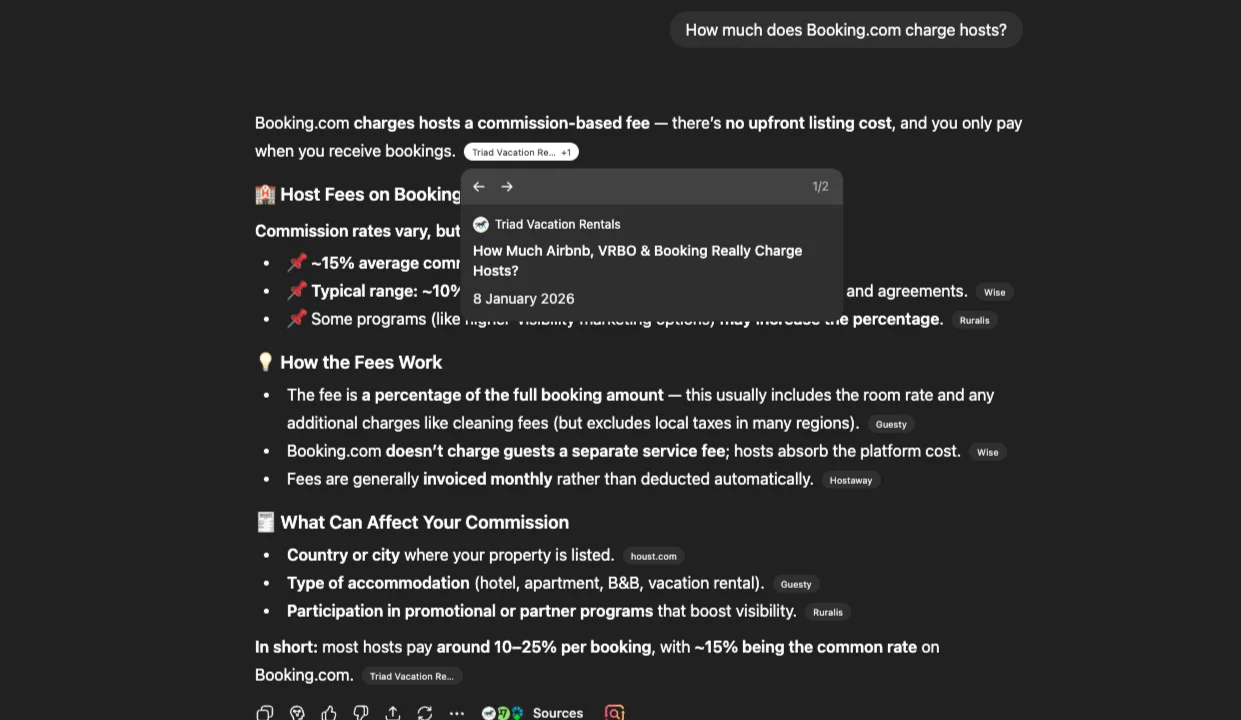
ChatGPT extracted the article's structure precisely: the two Airbnb fee models (split-fee vs. host-only), VRBO's 5% + 3% breakdown, and Booking.com's commission-based system. A site with five months of SEO history, cited ahead of established industry publications.
Google weighs domain authority heavily in rankings. AI systems evaluate differently. They look for content that completely answers a specific question, with real numbers and structure that can be extracted without losing meaning.
The article worked because it solved the comparison problem in one place instead of forcing readers to cross-reference three separate help centers. Every fee structure was broken down line by line with actual payout calculations. Not generic "hosts pay a percentage" statements, but real numbers showing what $150 becomes after each platform takes their cut. The comparison table gave AI systems a clean structure to extract without losing context. Even edge cases like Airbnb's split-fee versus host-only models were explained with examples, not just definitions.
It was also written by someone who actually needed this information while managing client content, not researched from a distance. That practical experience produced the level of precision that gets cited. This is where Google's E-E-A-T framework (Experience, Expertise, Authoritativeness, Trustworthiness) becomes relevant. AI systems respond to the same signals. Content written from real experience carries precision that research alone rarely achieves.
Domain size becomes secondary when the answer is this precise. Classic SEO logic would have flagged this topic as untouchable for a new domain. That logic isn't wrong for Google rankings. It just doesn't account for how AI systems now surface information.
This wasn't a calculated AEO strategy. We just built a resource Triad's hosts needed, and AI systems recognized the precision. It's replicable in any niche where major players own the obvious terms but rarely answer the specific questions practitioners actually deal with.
This wasn't a calculated strategy, just a real example of how AI systems evaluate and cite content. The principles are straightforward: complete answers, clean structure and real data.
No. Keyword research still drives most content decisions. This was a specific case where the competitive landscape made head terms unrealistic, so the focus shifted entirely to answering a question completely. The two approaches serve different situations.
SEO targets Google rankings. AEO (Answer Engine Optimization) targets AI systems like ChatGPT and Perplexity. Both reward quality, but AEO prioritizes completeness over domain authority.
E-E-A-T stands for Experience, Expertise, Authoritativeness, and Trustworthiness. It's Google's framework for evaluating content quality. The article was written by someone who actually needed the information while doing their job. That practical experience produced the level of precision that purely research-based content rarely achieves. AI systems respond to the same signal.
No. Different intent. ChatGPT users are researching options. Google users are ready to book. You want both.
No fixed timeline. We saw citations within eight weeks. Content with clear structure and real data gets picked up faster than broad coverage.
Google Analytics flagged referral traffic from ChatGPT. That's what prompted us to check. The citation was already there. Article title, brand name, publication date. Before we went looking for it.
Check what ChatGPT extracts from their content. Tables? Calculations? Examples? Then build something more complete with better structure. It's about precision, not domain authority.
Yes, particularly in niches where major publications cover topics broadly but not deeply. Find the specific question practitioners actually deal with, answer it completely with real data, and structure it cleanly.
Updates from projects we're working on and lessons we're learning.
Sent when there's actually something to say.