

Notes we’d send a friend
Updates from projects we're working on and lessons we're learning.
Sent when there's actually something to say.
If you've been following SEO in recent years, you've probably heard about E-E-A-T. But what does it actually mean? And why does Google care so much about it?
E-E-A-T stands for Experience, Expertise, Authoritativeness, and Trustworthiness—Google's framework for evaluating content quality. It's not a direct ranking factor you can "optimize" with a checklist. Instead, it's a set of principles that guide how Google's algorithms assess whether your content deserves to rank.
Here's the reality: In 2026, with AI-generated content flooding the internet and Google's AI Overviews appearing on 22-35% of searches globally—reaching up to 45% in the US for commercial queries, Google needs ways to separate genuinely helpful, trustworthy content from everything else.
That's where E-E-A-T comes in. And understanding it isn't optional anymore—it's essential.
E-E-A-T is Google's quality framework consisting of four interconnected elements:
Does the content creator have real, firsthand experience with the topic?
This is the newest addition to the framework (added in late 2022) and has become increasingly important. Google wants to know: Have you actually done what you're writing about?
Examples:
Experience is about demonstrating that you've been there, done that—not just researching and rewriting what others have said.
Does the content creator have the necessary knowledge, skills, or qualifications?
Expertise can be formal (degrees, certifications, professional credentials) or informal (years of hands-on practice, deep knowledge gained through experience).
Examples:
The level of expertise required depends on the topic. For complex, specialized topics—especially YMYL (Your Money or Your Life) content—formal credentials matter more.
Is the content creator or website recognized as a go-to source in their field?
Authority is about reputation and recognition. It's not just what you say about yourself—it's what others say about you.
Examples:
Authority takes time to build and is largely earned through consistent demonstration of expertise and experience.
Is the website legitimate, secure, and transparent? Can users trust the information and the source?
Trust is the foundation of everything else. Without it, experience, expertise, and authority don't matter.
Examples:
If users don't trust you, nothing else matters.
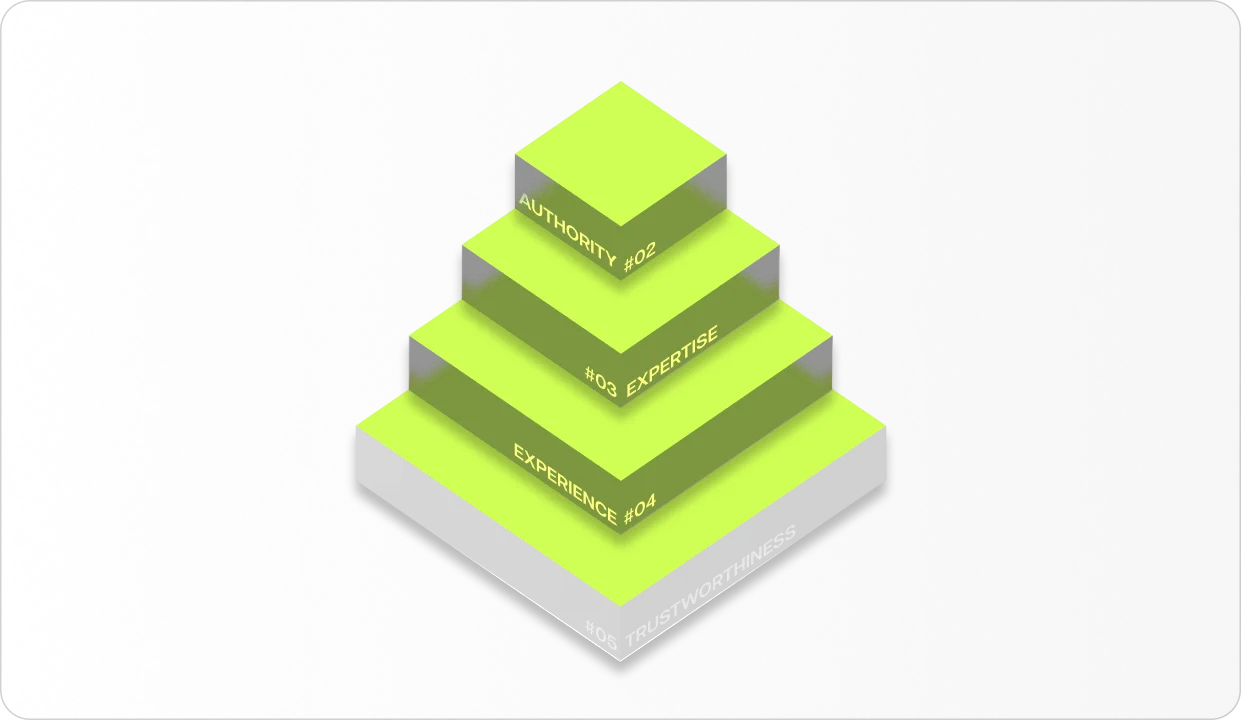
Not all four elements carry equal weight. Google's Quality Rater Guidelines make it clear that there's a hierarchy:
Short answer: No.
Longer answer: It's more important than most ranking factors.
E-E-A-T isn't something Google's algorithm can measure directly like page speed or mobile-friendliness. There's no "E-E-A-T score" that determines your rankings.
Instead, E-E-A-T is a conceptual framework that Google's algorithm tries to approximate using hundreds of actual signals:
Google's algorithm looks at all of these (and more) to assess whether your content demonstrates E-E-A-T principles. Sites with strong signals across the board tend to rank better, earn more visibility in AI Overviews, and maintain rankings more consistently over time.

Understanding E-E-A-T isn't just about SEO theory—it has direct, measurable effects on your website's performance:
Sites with strong E-E-A-T signals consistently rank higher and more stably. Google's algorithm favors content from sources it can trust.
In our work with service-based businesses, we've seen the biggest trust improvements when we implement detailed author bios with measurable experience—years of practice, number of completed projects, and relevant certifications. Sites with authentic author expertise consistently rank faster and appear more frequently as sources in AI Overviews.
Websites with solid E-E-A-T tend to weather algorithm updates better. When Google makes changes, sites with genuine expertise and trustworthiness maintain their positions while lower-quality sites fluctuate.
As AI Overviews become more prevalent, sites with strong E-E-A-T are far more likely to be cited as sources. This means visibility even when users don't click through to traditional search results.
E-E-A-T affects your entire domain, not just individual pages. Building trust on one part of your site can help lift other pages. Conversely, low-quality content anywhere on your site can drag down the whole domain's perceived trustworthiness.
The most common E-E-A-T mistake we encounter with new clients: mixing anonymous content with signed articles. This inconsistency directly undermines site-wide trust and makes it nearly impossible to rank consistently, especially in competitive niches.
The rise of AI Overviews has made E-E-A-T more important, not less.
When Google's AI generates summaries, it pulls information from sources it trusts. Sites with strong E-E-A-T signals are far more likely to be cited as references in these AI-generated summaries.
What this means practically:
• Being cited matters more than ranking #1. A site with strong E-E-A-T might appear as a cited source in an AI Overview even if it ranks #3 or #4 in traditional results.
• Thin content gets buried completely. Generic, surface-level content that lacks genuine expertise or experience won't be cited or ranked well.
• First-person experience stands out. Content that clearly demonstrates "I did this" or "I've seen this in practice" is more valuable to AI systems trying to synthesize authoritative information.
The bar for quality content has risen dramatically. Generic, AI-generated, or experience-free content struggles to compete against genuinely authoritative sources.
Building E-E-A-T isn't a quick fix—it's an ongoing commitment to quality and authenticity. Here's where to start:
• Demonstrate firsthand involvement. Use first-person language, specific examples, and details that only someone with real experience would know.
• Share case studies and real results. Show what you've actually done, not just what's theoretically possible.
• Include behind-the-scenes content. Photos from job sites, before-and-after comparisons, process documentation—anything that proves you do this work.
• Create comprehensive, detailed content. Go deeper than surface-level explanations. Show that you understand the nuances and complexities.
• Cite credible sources. Back up your claims with research and data from authoritative sources.
• Highlight credentials appropriately. If you have relevant degrees, certifications, or training, make them visible—but don't inflate qualifications you don't have.
• Earn backlinks from reputable sites. Create content others want to reference and share.
• Get featured in industry publications. Guest posts, interviews, and citations from recognized sources build authority.
• Build consistent brand mentions. Even unlinked mentions of your brand across the web contribute to perceived authority.
• Be transparent about who you are. Detailed author bios, clear contact information, and company details build trust.
• Maintain accuracy. Fact-check your content and update it when information changes.
• Secure your site properly. HTTPS, clear privacy policies, and secure payment processing are baseline requirements.
• Handle negative feedback professionally. How you respond to criticism says a lot about trustworthiness.

Not every website needs the same level of E-E-A-T. Google's standards vary based on the potential for harm:
Topics that could significantly impact health, financial stability, safety, or well-being:
Requirements: Formal credentials are often essential. Content should be created by recognized professionals. High standards for accuracy and sourcing.
Topics requiring significant expertise or where misinformation could cause moderate harm:
Requirements: Strong demonstration of experience and expertise. Professional credentials are helpful but not always required if substantial experience is clearly demonstrated.
General topics where expertise adds value but the stakes are lower:
Requirements: First-person experience and genuine interest matter most. Formal expertise is less critical, but the content should still be accurate and helpful.
Publishing content without clear authorship signals low E-E-A-T. Every important piece of content should have a named author with a detailed bio.
Claiming expertise you don't have is worse than having no credentials. Be honest about your level of experience and knowledge.
Surface-level content that could have been written by anyone (or by AI) without real knowledge doesn't demonstrate E-E-A-T.
Having some high-quality, expert content mixed with low-quality filler content undermines your site's overall E-E-A-T.
Lacking basic trust elements—no contact information, no privacy policy, poor site security—hurts credibility regardless of content quality.
Publishing content once and never updating it suggests you're not actively engaged with the topic. Regular updates show ongoing expertise.
Before investing in major E-E-A-T improvements, assess your current state:
Check these essential signals:
✓ Does your content show firsthand experience (first-person language, specific examples)?
✓ Are authors clearly identified with relevant credentials and detailed bios?
✓ Do you have backlinks from authoritative sites in your industry?
✓ Is your site secure (HTTPS) with clear contact information?
✓ Are privacy policies and terms of service visible and complete?
✓ Do you cite credible sources where appropriate?
✓ Are your author bios more detailed than your competitors'?
✓ Does anonymous content anywhere on your site undermine trust?
If you answered "no" to multiple questions, E-E-A-T improvements should be your top SEO priority.
Compare your signals against the competitors ranking above you. The gaps you find are your roadmap for improvement.
E-E-A-T isn't going anywhere—if anything, it's becoming more central to how Google evaluates content.
As AI tools make it easier to generate content at scale, the ability to demonstrate genuine experience, expertise, authority, and trust becomes the key differentiator. Sites that invest in building real E-E-A-T will have a lasting competitive advantage.
Google's focus on "helpful content created by people, for people" is essentially E-E-A-T in different words. The businesses that understand this and commit to building authentic expertise and trust will thrive in search, regardless of how algorithms evolve.
At its core, E-E-A-T isn't about gaming an algorithm or checking boxes. It's about being the kind of source you'd trust if you were searching for information.
Ask yourself: If you needed advice on this topic, would you trust your own site? Would you recommend it to a friend or family member? If the answer is yes, you're on the right track.
Building E-E-A-T takes time. It requires genuine expertise, consistent demonstration of experience, earning recognition from others, and maintaining trustworthiness across everything you do. There are no shortcuts.
But here's the reality: In 2026, you don't rank because you optimized keywords better than your competitors. You rank because you're a source that Google and users trust. If your site doesn't demonstrate real knowledge and experience, AI will summarize you—or skip you entirely.
E-E-A-T isn't a tactic. It's the new baseline for survival in organic search.
Sites with strong E-E-A-T don't just rank better—they build loyal audiences, earn sustainable traffic, and create lasting value that goes far beyond SEO.
E-E-A-T stands for Experience, Expertise, Authoritativeness, Trustworthiness—Google's framework for evaluating content quality. In 2026, it separates trustworthy, expert content from AI-generated fluff. Sites with strong E-E-A-T rank better and get cited in AI Overviews.
No, but it's more important than most ranking factors. E-E-A-T isn't a metric Google measures directly. Instead, Google's algorithm approximates it using 100+ signals: author credentials, backlinks, content depth, site security, updates, and first-person examples. Strong signals across the board = better rankings.
Trustworthiness is the foundation (without it, nothing else matters). But Experience is now the biggest differentiator—demonstrating that you've actually done what you're writing about. A contractor's advice ranks higher than a writer's advice, even if the writing is better.
Not necessarily. Expertise can be formal (degrees, certifications) or informal (years of hands-on experience). For general topics, experience matters most. For YMYL topics (medical, financial, legal advice), formal credentials are often essential.
Anonymous content signals low E-E-A-T because Google can't evaluate the author's credibility. Mixing anonymous with signed content undermines your entire site's trustworthiness. Named authors with detailed bios = stronger signals across the board.
E-E-A-T isn't a quick fix—it's built over months and years. You need consistent quality content, earned backlinks from authoritative sites, visible author credentials, and demonstrated real-world experience. Sites with strong E-E-A-T typically see stable rankings and better resilience during algorithm updates.
No. YMYL topics (health, finance, legal, safety) require the highest standards—formal credentials essential. Important topics (construction, major purchases, parenting) need strong experience + expertise. General topics (hobbies, reviews, lifestyle) just need honest first-person experience.
Mixing high-quality expert content with thin, generic filler content. This inconsistency undermines your site's overall E-E-A-T. Every page matters—one piece of low-quality content drags down your entire domain's credibility.
Updates from projects we're working on and lessons we're learning.
Sent when there's actually something to say.